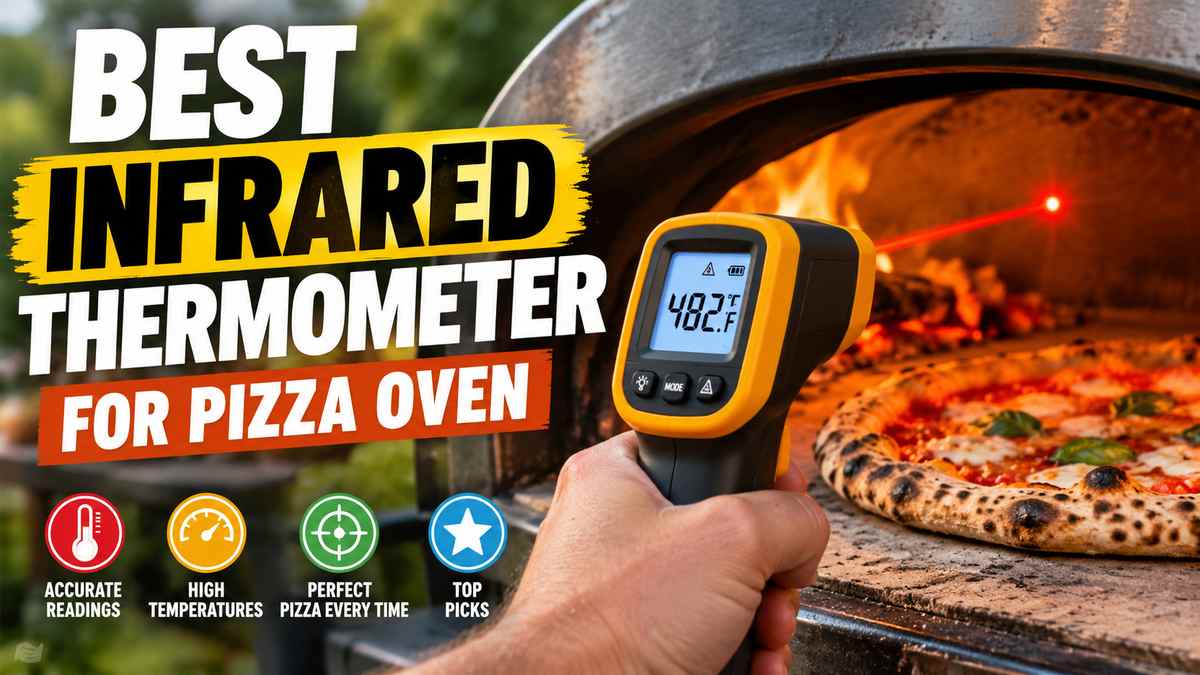
7 Best Infrared Thermometers for Pizza Ovens (Researched for 2026)
The best infrared thermometer for pizza oven use must read past 750°F, and many budget guns can't. We compared 7 research-backed IR guns on temperature range, emissivity, and distance-to-spot ratio so you can launch every pizza at the right stone temperature. (48 words)
Quick Comparison Table
| Image | Product | Key Feature | Buy Now |
|---|---|---|---|
| Etekcity Lasergrip 1260 Infrared Thermometer 🏆 Best Overall | 1130°F maximum range: Reads stone and dome surfaces hot enough for 60–90-second Neapolitan bakes, with margin above the 750–950°F window most pizza ovens target. | Buy Now | |
| Etekcity Lasergrip 774 Infrared Thermometer 💰 Best Budget Pick | −58°F to 716°F range: Handles home-oven stones and steels (500–550°F territory) and grill work comfortably. | Buy Now | |
| Ooni Digital Infrared Thermometer 👑 Best Premium Pick | Cordierite-stone calibration: Comes pre-calibrated for the emissivity of Ooni's baking stones, reducing the setup most generic guns require. | Buy Now | |
| 1472°F Adjustable-Emissivity IR Temperature Gun 💰 Best High-Range Value | 1472°F maximum range: The highest ceiling in this guide — headroom even for domes and flames-adjacent surfaces that push past 1100°F. | Buy Now | |
| TempPro TempScan Infrared Thermometer (12:1) 💰 Best Value Under $25 | −58°F to 1112°F range: Reads fully fired pizza stones with headroom, matching guns that cost $30+. | Buy Now | |
| Etekcity Dual Laser Infrared Thermometer (1022°F) 🏆 Best for Precise Aiming | Dual crosshair lasers: Bracket the actual measurement spot so you can see — not guess — what the gun is reading on the stone floor. | Buy Now | |
| TempPro TempScan 2-Laser Infrared Thermometer (16:1) 🏆 Best for Distance Readings | 16:1 distance-to-spot ratio: A noticeably tighter measurement spot than 12:1 guns at the same distance — better isolation of the stone's hot center. | Buy Now |


Tested & Recommended Amazon Products
Research-based comparisons • No hands-on testing
Why the Etekcity Lasergrip 1260 leads our list: Based on its published specifications, it is the only pick under $30 that combines the three specs that matter most for pizza work — a 1130°F maximum range with real headroom above the 750–950°F surface temps pizza stones reach, fully adjustable emissivity (0.1–1.0) so you can tune readings for stone, steel, or oven dome, and a 12:1 distance-to-spot ratio that keeps your measurement spot small at realistic aiming distances. Its accuracy rating (±2% or ±3.6°F) and sub-500ms response match what independent reviewers reward in far costlier guns, and its ~37,600 Amazon ratings give it the deepest reliability track record in this roundup. That's an editorial judgment based on specification and market-track-record research, not hands-on testing — but on paper, no other pick covers the pizza use case this completely at this price.
🌟 Key Features That Stand Out
- ✓ 1130°F maximum range: Reads stone and dome surfaces hot enough for 60–90-second Neapolitan bakes, with margin above the 750–950°F window most pizza ovens target.
- ✓ Adjustable emissivity (0.1–1.0): Tune the setting for matte cordierite stone, polished baking steel, or the oven's interior so readings reflect the surface you're actually measuring.
- ✓ 12:1 distance-to-spot ratio: At 12 inches from the stone, the gun measures a spot roughly 1 inch across — small enough to isolate the floor from cooler edges.
- ✓ Stated accuracy of ±2% or ±3.6°F: Etekcity's published tolerance is in line with what independent testing labs reward in this price class.
- ✓ Fast response time (<500 ms): Trigger-pull readings land quickly, so you can scan the floor in several spots between launches.
- ✓ Non-contact point-and-shoot design: No probes or wires near a 900°F oven mouth; aim, pull the trigger, read.
💡 Why We Recommend It
🎯 Best For
✅ Pros
- 1130°F max range covers every home pizza oven use case with headroom
- Fully adjustable 0.1–1.0 emissivity for accurate readings on stone, steel, and dome surfaces
- Published ±2% / ±3.6°F accuracy and sub-500 ms response time
- Enormous, long-running Amazon review base (approx. 37,600 ratings at 4.6★)
- 12:1 optics keep the measured spot reasonably small at pizza-oven aiming distances
❌ Cons
- 12:1 optics are less precise at long distances than 16:1 or 30:1 guns
- No dual-laser spot visualization
- Generic branding carries less kitchen-gadget cachet than oven-maker accessories
🌟 Key Features That Stand Out
- ✓ −58°F to 716°F range: Handles home-oven stones and steels (500–550°F territory) and grill work comfortably.
- ✓ Fixed 0.95 emissivity: Zero settings to fiddle with — 0.95 is a good match for matte pizza stones, though it can't be tuned for shiny surfaces.
- ✓ 12:1 distance-to-spot ratio: Same optics class as guns costing twice as much.
- ✓ ±2% or 2°C stated accuracy: Respectable tolerance for surface readings in its class.
- ✓ Proven track record: Roughly 48,800 Amazon ratings — the deepest review base of any gun in this guide.
💡 Why We Recommend It
🎯 Best For
✅ Pros
- Typically the lowest price among reputable-brand guns (about $17 at research time)
- Largest review base in the category — roughly 48,800 ratings at 4.6★
- Fixed 0.95 emissivity suits matte pizza stones without any setup
- 12:1 optics and ±2% accuracy match pricier entry guns
- Doubles as a capable grill, griddle, and HVAC gun
❌ Cons
- 716°F maximum cannot read fully fired pizza-oven stones (750–950°F)
- Non-adjustable emissivity limits accuracy on steel and reflective surfaces
🌟 Key Features That Stand Out
- ✓ Cordierite-stone calibration: Comes pre-calibrated for the emissivity of Ooni's baking stones, reducing the setup most generic guns require.
- ✓ Adjustable emissivity: Re-tune the setting to read baking steel and other surfaces accurately.
- ✓ Sub-300-millisecond readings: Faster stated response than the <500 ms class most budget guns quote.
- ✓ Color-coded full-color LCD: Visual temperature feedback at a glance — useful when you're peering into a roaring oven mouth.
- ✓ Temperature scan mode: Reports min/max/average across the stone, exposing hot and cold zones a single spot reading can miss.
- ✓ Accuracy to within 4°F: Ooni's stated tolerance, verified on its official product page.
💡 Why We Recommend It
🎯 Best For
✅ Pros
- Purpose-built and factory-calibrated for pizza-oven baking stones
- Min/max/average scan mode maps hot and cold zones across the stone
- Fastest stated response time in this roundup (under 300 ms)
- Color-coded LCD makes hot-vs-ready judgment instantaneous
- Adjustable emissivity extends accuracy to baking steel and other surfaces
❌ Cons
- Highest price in the guide ($64.95 vs. $15–$33 for the alternatives)
- Temperature range and D:S ratio not published, so specs can't be fully compared
- Some Ooni-community owners report inconsistent readings in real use
- Small Amazon review base (approx. 369 ratings) relative to rivals
🌟 Key Features That Stand Out
- ✓ 1472°F maximum range: The highest ceiling in this guide — headroom even for domes and flames-adjacent surfaces that push past 1100°F.
- ✓ Adjustable emissivity: Tunable for stone, steel, and reflective interior surfaces.
- ✓ Over-temperature alarm: Audible alert when a surface crosses your set threshold — a set-and-forget guard against over-firing the floor.
- ✓ Backlit LCD: Readable in evening and low-light patio cooking conditions.
- ✓ Lowest price in the guide: About $15 at research time.
💡 Why We Recommend It
🎯 Best For
✅ Pros
- Highest stated maximum range in the guide (1472°F)
- Cheapest pick at about $15 at research time
- Adjustable emissivity for multi-surface accuracy
- Over-temperature alarm adds passive threshold monitoring
- Backlit display for low-light outdoor cooking
❌ Cons
- Brand and model identity unclear in the listing
- D:S ratio and accuracy specs could not be verified from a primary source
- Thinner review base (approx. 2,000 ratings) than the leading picks
🌟 Key Features That Stand Out
- ✓ −58°F to 1112°F range: Reads fully fired pizza stones with headroom, matching guns that cost $30+.
- ✓ Adjustable emissivity (0.1–1.00): Per TempPro's own documentation, tunable across the full practical range with a 0.95 default.
- ✓ 12:1 distance-to-spot ratio: At 12 inches, the measured spot is roughly 1 inch across.
- ✓ Backlit display selection and auto-shutoff: Battery-conscious design per TempPro's published feature guide.
- ✓ Pizza-oven-first marketing: Listing is built around pizza, griddle, and cooking use rather than industrial repurposing.
💡 Why We Recommend It
🎯 Best For
✅ Pros
- 1112°F range and adjustable emissivity match guns costing 30–50% more
- 12:1 optics confirmed by the manufacturer's own documentation
- Strong review base (approx. 9,800 ratings at 4.6★) with Best Seller badge
- Marketed specifically for pizza ovens and griddles
- Backlit display with battery-saving auto-shutoff
❌ Cons
- Formal accuracy tolerance not published the way Etekcity's is
- Multiple range variants share the listing (932°F and 1112°F), requiring careful selection
🌟 Key Features That Stand Out
- ✓ Dual crosshair lasers: Bracket the actual measurement spot so you can see — not guess — what the gun is reading on the stone floor.
- ✓ −58°F to 1022°F range: Covers stone surface temperatures across every mainstream home pizza oven style.
- ✓ Established Etekcity platform: Shares lineage with the guide's best-reviewed guns (combined Lasergrip review base well over 90,000 ratings).
- ✓ Non-contact point-and-shoot operation: Standard trigger-style IR reading with no probe placement.
💡 Why We Recommend It
🎯 Best For
✅ Pros
- Dual crosshair lasers visibly bracket the true measurement spot
- 1022°F range suits gas, electric, and most wood-fired pizza ovens
- Strong review base (approx. 10,500 ratings at 4.6★) with Best Seller badge
- Etekcity build quality and support ecosystem
❌ Cons
- D:S ratio, emissivity range, and accuracy not verifiable from primary documentation
- Slightly less range headroom than the Lasergrip 1260
- Costs a few dollars more than our top pick for a narrower feature advantage
🌟 Key Features That Stand Out
- ✓ 16:1 distance-to-spot ratio: A noticeably tighter measurement spot than 12:1 guns at the same distance — better isolation of the stone's hot center.
- ✓ Dual lasers: Mark the spot's boundaries so you can verify exactly what's being measured before trusting the number.
- ✓ TempScan platform features: Same product family as our value pick, including adjustable emissivity per TempPro's documentation (variant-specific confirmation pending).
- ✓ Pizza-oven positioning: Marketed for pizza ovens and grills specifically.
💡 Why We Recommend It
🎯 Best For
✅ Pros
- 16:1 optics deliver a tighter spot than every other gun in this price bracket
- Dual lasers confirm spot boundaries at long aim distances
- Best Seller badge and a solid 4.6★ from approx. 1,200 ratings
- Family platform is documented for adjustable emissivity (per TempPro guides)
❌ Cons
- Variant's temperature range and emissivity not confirmed from a primary source
- Smallest brand-name review base in the guide
- Tighter optics add cost without benefit for compact portable ovens
🏆 Our Top Pick
How to Choose the Best Infrared Thermometer for a Pizza Oven
Every infrared thermometer looks the same in a product photo — a pistol grip, a laser dot, an LCD. The differences that actually matter for pizza work hide in four specification lines that many listings bury or omit entirely. Here's how to read them.
Maximum Temperature Range: The Non-Negotiable Filter
pizza stones in dedicated ovens run far hotter than most cooking surfaces. Gozney's own guidance recommends 750–930°F for pizza baking, and ThermoWorks' stone-fired pizza testing centers on stone temperatures in the mid-700s°F, with wood-fired domes climbing higher still. Any gun whose ceiling sits below roughly 750°F will display an over-range error precisely when you need it. That's why our first filter eliminated a large share of Amazon's IR listings: many cheap guns top out at 400–716°F, adequate for home ovens and HVAC but not for Neapolitan-style baking. For gas and electric pizza ovens, look for a 1000°F-plus ceiling; for wood-fired ovens, 1100°F-plus gives comfortable headroom for dome and flame-adjacent readings. Treat the stated maximum as a hard filter, not a nice-to-have.
Distance-to-Spot (D:S) Ratio: The Spec Most Buyers Ignore
The D:S ratio describes how large an area the gun measures relative to how far away you stand. A 12:1 gun aimed from 12 inches reads a spot roughly 1 inch across; the same gun from 24 inches reads a 2-inch circle. This matters enormously on a pizza stone, where the floor's center can be 100°F hotter than its edge, and a large spot "averages" those zones into a misleading number. ThermoWorks' buying guide notes that 30:1-class optics — able to measure the same spot size from double the distance of a 12:1 gun — are the professional standard for exactly these hard-to-reach, extremely hot targets, though they command industrial prices. For most home pizza makers, 12:1 is adequate if you aim from close range deliberately; 16:1 is the practical sweet spot for larger ovens; and whatever your ratio, the rule is the same: get closer than feels necessary and aim at the floor, not the flames.
Emissivity: Fixed vs. Adjustable Is the Accuracy Decision
Emissivity describes how efficiently a surface radiates infrared energy, on a scale of 0 to 1.0. Matte, rough surfaces like cordierite pizza stones behave well at the 0.95 default most guns assume. But shiny or low-emissivity surfaces — polished baking steel, glazed tiles, the metal interior of an oven dome — radiate differently, and measurement specialists at Fluke document how low-emissivity surfaces cause IR guns to under-report actual temperature. That's the mechanism behind the most common pizza-forum complaint: "my gun says 650 but my oven is clearly hotter." A fixed-emissivity gun (like the Lasergrip 774 at 0.95) is fine for matte stone and zero-fuss operation. An adjustable gun (0.1–1.0, like the Lasergrip 1260 and TempScan) lets you correct for steel and reflective surfaces — one of the clearest "worth paying extra for" features in this category.
Accuracy Rating and Response Time
Reputable manufacturers publish an accuracy tolerance, typically expressed as ±2% of reading or ±3–4°F, whichever is greater — the format Serious Eats' testing of infrared thermometers uses to score candidates. If a listing publishes no accuracy figure at all, treat that as a warning sign: it usually means the maker didn't want to commit to a number. Response time matters less for pizza than for HVAC, but anything under 500 ms lets you sweep the stone floor quickly; Ooni's sub-300 ms gun and the sub-500 ms class of most brand-name units are both entirely adequate.
Display, Controls, and Ease of Use
Pizza-oven readings happen in bright daylight and at dusk on a patio, so a backlit display earns its keep quickly. Look for: a trigger-style activation you can operate one-handed while holding a peel in the other; an ambient-temperature or scan-hold function that keeps the reading on screen after you release the trigger; and simple °F/°C switching. Advanced touches like Ooni's color-coded display and min/max/average scan mode genuinely help interpret a stone's hot and cold zones, but they're conveniences, not requirements — a basic max-hold function covers the essential workflow.
Build Quality and Heat Handling
An IR gun lives near a 900°F oven, so construction matters more than it would for a kitchen timer. Verify the gun's own maximum operating-temperature rating (most consumer units tolerate ambient conditions up to around 100–120°F — never store one inside a hot oven bay or on the oven's ledge). A housing with some heat standoff at the nozzle, a lanyard or hang loop for storage away from the oven, and a protective case (the OnniOne-style bundles include one) all extend usable life. Lasers in these tools are Class 2 devices (<1 mW) and safe for incidental exposure, but never stare into the beam or aim it at eyes — including reflections off the stone.
Maintenance, Batteries, and Ongoing Costs
Nearly all consumer IR guns run on a 9V battery, and the IR sensor itself requires no calibration for cooking purposes — though measurement-grade users can verify against a known reference such as boiling water (212°F at sea level). Keep the lens clean: a smudged or dusty aperture distorts readings just as a dirty camera lens distorts photos, and a microfiber wipe is all the maintenance most units ever need. Factor battery replacement into the true cost of ownership — at $15–$65 up front, it's trivial, but a dead 9V discovered mid-preheat is a genuine pizza-night annoyance, so keep a spare.
Budget and Value Tiers
Based on our October 2026 Amazon research, the market divides into three tiers. Budget ($15–$20): fixed-emissivity guns in the 716°F class — fine for home ovens, limited for dedicated pizza ovens. Midrange ($20–$35): the sweet spot, where 1000–1130°F ranges, adjustable emissivity, and 12:1–16:1 optics converge — our top three value picks all live here. Premium ($50+): oven-brand accessories (Ooni at $64.95, Gozney's equivalent at $49.99 direct) that charge for calibration convenience and ecosystem match rather than raw specification superiority. Pizza-community discussions, including r/pizzaoven threads, openly debate whether oven-brand guns justify their premium; our research suggests the midrange generic-brand tier is where specification-per-dollar peaks.
Common Buying Mistakes
Four mistakes account for most bad purchases in this category. First: buying on price alone and landing a 500–700°F gun that can't read a hot stone — check the maximum range before anything else. Second: ignoring the D:S ratio, then aiming from three feet away and wondering why the reading seems low. Third: assuming the laser dot marks the measurement spot — on single-laser guns it's only a pointer, and the actual spot is a circle several times larger. Fourth: expecting an IR gun to read air temperature or internal dough temperature — it reads surface radiation only, which is why serious pizza makers eventually pair one with a probe thermometer. Avoid these four and even a $20 gun will serve you well; commit any of them and even a $65 gun will disappoint.
Practical Tips for Getting the Most From Your Pizza Oven Infrared Thermometer
1. Aim at the stone floor, not the dome or flames. The floor temperature — not air temperature — determines how your base bakes. Sweep the floor's center and a few inches in from the walls, avoiding any visible flame or ember, which reads falsely hot and can even exceed the gun's range.
2. Get closer than feels comfortable. Whatever your gun's D:S ratio, halving your distance quarters your spot size. A reading taken 6 inches over the stone center is dramatically more meaningful than one taken from the counter. Keep the gun a safe, comfortable distance from the oven mouth — tighter optics like the 16:1 TempScan let you keep your knuckles further from the heat without losing precision.
3. Take three readings and use the pattern, not one number. Stone floors are never uniform. Read center, one edge zone, and one back-corner spot before your first launch. If the spread exceeds 50–75°F, rotate or reposition the stone or adjust your launch zone rather than trusting any single number.
4. Re-check between every pie. Each launch drops the floor temperature by dozens of degrees. The stone needs a recharge period before the next pizza — the IR gun is the only way to know when it's genuinely ready again, which is exactly the use case Ooni designed its thermometer around.
5. Adjust emissivity when you switch surfaces. Matte stone at the default 0.95 reads true; when you check a baking steel or the metal dome interior, lower the emissivity setting accordingly (or treat steel readings as approximate). Fluke's measurement guidance documents how skipping this step causes systematic under-reading on shiny surfaces.
6. Use the max-hold or scan mode during preheat. Trigger the gun periodically during the preheat ramp and watch the maximum reading climb rather than chasing instantaneous spot values. Watching the trend plateau tells you the stone is saturated — the single most useful habit for consistent bakes.
7. Keep the lens clean and the gun cool. Wipe the sensor aperture with a dry microfiber cloth occasionally, and never leave the gun on or inside the hot oven structure — consumer IR guns are rated for modest ambient temperatures, and heat damage kills sensors silently.
8. Verify it occasionally against a known reference. A cup of ice water (the wet ice surface should read near 32°F) or boiling water (≈212°F at sea level) is a free sanity check. If a gun drifts badly from those references, trust the reference, not the gun.
Infrared Thermometer vs. Probe Thermometer for Pizza: Which Do You Actually Need?
They measure fundamentally different things, and serious pizza setups eventually include both. An infrared gun reads surface temperature — the stone floor, the dome wall, a griddle — instantly and without contact, which is exactly what launch-timing decisions require. A probe thermometer reads internal temperature — the dough's interior, the oven's air space, or a meat roast — and can be left in place to log a trend. For pizza specifically, the IR gun answers "is my stone ready to launch?" and "has the floor recharged between pies?"; the probe answers "is my dough's interior done?" and "what is my oven's air temperature over the whole bake?" Air temperature matters for dome-heavy Neapolitan style (the leoparding on top comes from hot air and radiant dome heat, not the floor), which is why oven makers like Gozney publish both dome and floor guidance. If you can only buy one, buy the IR gun — stone temperature is the variable home pizza makers control least well by feel — and add a cheap probe later if you chase consistency further.
Final Thoughts: Which Infrared Thermometer for Pizza Ovens Should You Buy?
Strip away the marketing and this category comes down to three specifications — maximum range, distance-to-spot ratio, and emissivity flexibility — plus one trust factor, the manufacturer's track record. Our research-based conclusion: for most dedicated pizza-oven owners, the Etekcity Lasergrip 1260 ($24.99) is the best overall infrared thermometer for pizza oven use, combining a 1130°F ceiling, adjustable emissivity, verified optics, and one of the deepest review histories on Amazon. Budget buyers baking in a conventional home oven will be well served by the Lasergrip 774 ($16.99) — with the clear caveat that its 716°F max cannot read a fully fired dedicated oven's stone. Ooni owners who value zero-setup convenience and zone scanning should consider the Ooni Digital Infrared Thermometer ($64.95), and large-oven owners who read from a distance should look at the 16:1 TempPro TempScan ($32.99). The single most important consideration in any case: verify the maximum temperature range exceeds 750°F before you buy anything else, because no other spec matters if the gun maxes out exactly when your stone reaches its sweet spot.