
Best Silicone Egg Bite Molds for Oven and Air Fryer: 7 Picks Compared
Comparing the best silicone egg bite molds for oven and air fryer use: cavity size, heat resistance, lids, rigid frames, air fryer fit, cleaning, and which mold to buy.
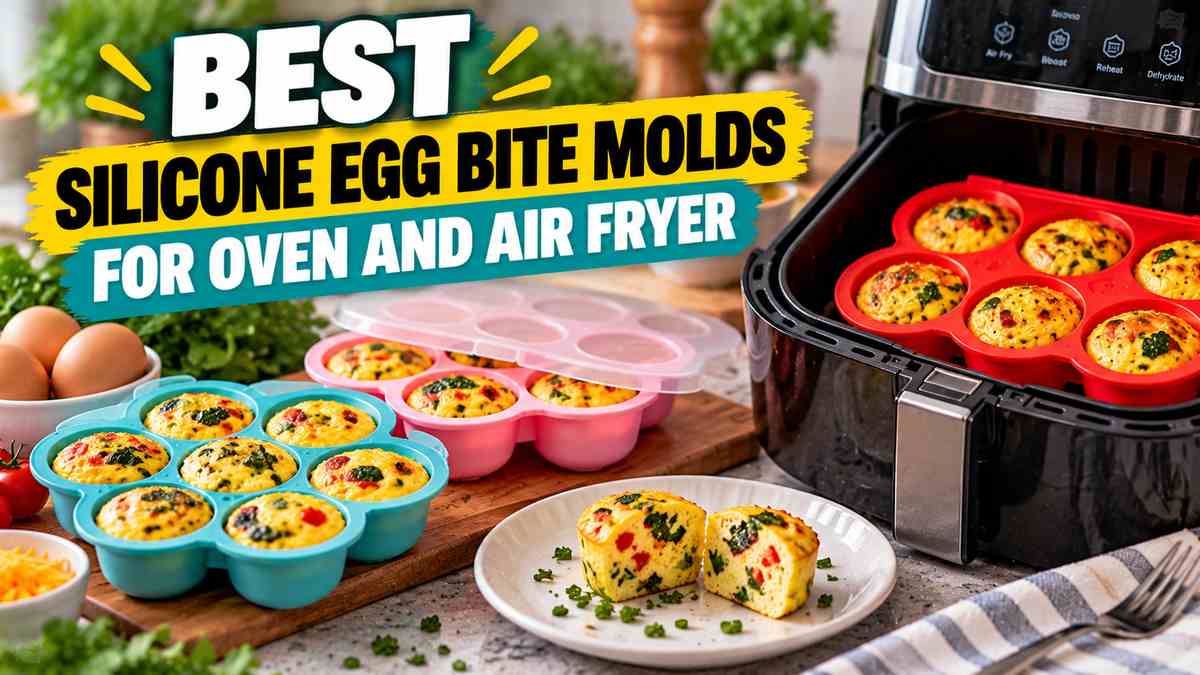
Quick Comparison Table
| Image | Product | Key Feature | Buy Now |
|---|---|---|---|
| Sakolla 2-Pack 7-Cup Silicone Egg Bite Molds 🏆 Best for Air Fryer Baskets | Seven cups per tray, two trays included: fourteen wells per purchase, which is the difference between two baking passes and four when making breakfast for a family. | Buy Now | |
| SHEbaking 7-Cup Silicone Egg Bite Mold 👑 Best Premium | Single seven-cup tray: the standard egg bite format in one compact pan that fits flat in a drawer. | Buy Now | |
| BRONYPRO 12-Cup Silicone Muffin Pan with Metal Frame 🏆 Best Complete Set | Twelve regular-size cups: a full standard muffin-pan batch per session — roughly seventy percent more capacity than a seven-cup egg bite tray. | Buy Now | |
| Vinino Silicone Air Fryer Muffin Pan with Reinforced Frame 🏆 Best with a Lid | Reinforced frame: supports the silicone body so the pan keeps its shape while loaded, which is what makes one-handed transfer into a hot basket realistic. | Buy Now | |
| Redfly 3-Inch Silicone Egg Molds 💰 Best Budget Single Tray | Twelve cavities across two trays: six wells per tray gives you a full batch of sandwich rounds plus a spare tray to fill while the first bakes. | Buy Now | |
| 7-Piece Silicone Egg Bites Mold Set with Steamer Rack 🏆 Best All-in-One Instant Pot Kit | Steamer rack included: keeps the mold elevated above the inner pot’s base, which is how pressure-cooker egg bites are normally cooked. | Buy Now | |
| Instant Pot Official Silicone Egg Bites Pan with Lid ⚡ Best for Breakfast Sandwiches | Lid included: the pan can be covered for pressure-cooker cooking, refrigerated for storage, or carried without the batter skinning over. | Buy Now |


Tested & Recommended Amazon Products
Research-based comparisons • No hands-on testing
Comparing the best silicone egg bite molds for oven and air fryer use: cavity size, heat resistance, lids, rigid frames, air fryer fit, cleaning, and which mold to buy.
🌟 Key Features That Stand Out
- ✓ Seven cups per tray, two trays included: fourteen wells per purchase, which is the difference between two baking passes and four when making breakfast for a family.
- ✓ Nonstick silicone wells: the listing describes a nonstick silicone body; flexible wells of this type typically release by pressing upward from underneath once the bites have rested.
- ✓ Two-tray batch workflow: bake one tray while the other cools and releases, which addresses the real bottleneck in egg bite cooking — not oven time, but turnaround time.
- ✓ Air fryer muffin-pan format: marketed explicitly as an air fryer pan as well as an oven mold, so it is designed for single-basket and drawer-style cookers rather than only for a pressure cooker.
- ✓ Multi-purpose cavities: listed for egg bites, mini muffins, tarts, mini cupcakes, and quiche — one pan covering several jobs instead of three single-use pans.
- ✓ Color-coded pair in pink and green: small but genuinely useful when the two trays are holding different batters, or when one is in the freezer and one is in the oven.
💡 Why We Recommend It
🎯 Best For
✅ Pros
- Two seven-cup trays — 14 wells per purchase, the highest capacity-per-order in this shortlist
- Flexible nonstick wells release bites without dedicated liners
- One mold covers egg bites, mini muffins, tarts, mini cupcakes, and quiche
- Explicitly designed for air fryer use, not only oven or pressure cooking
- Color-coded trays simplify batch tracking and freezer storage
- Carried an Amazon’s Choice designation in the search data reviewed, signaling sustained demand
❌ Cons
- Two seven-cup trays — 14 wells per purchase, the highest capacity-per-order in this shortlist
- Flexible nonstick wells release bites without dedicated liners
- One mold covers egg bites, mini muffins, tarts, mini cupcakes, and quiche
- Explicitly designed for air fryer use, not only oven or pressure cooking
- Color-coded trays simplify batch tracking and freezer storage
- Carried an Amazon’s Choice designation in the search data reviewed, signaling sustained demand
🌟 Key Features That Stand Out
- ✓ Single seven-cup tray: the standard egg bite format in one compact pan that fits flat in a drawer.
- ✓ Nonstick silicone construction: the listing states a nonstick surface, which is what allows release by pressing the well from underneath.
- ✓ BPA-free material claim: stated on the listing rather than left to inference.
- ✓ Air fryer egg mold positioning: marketed for air fryer use as well as oven baking, so the shape assumes a round basket.
- ✓ Multi-use cavities: listed for egg bites, mini muffins, tarts, and mini cupcakes.
- ✓ Large verified customer base: the highest review volume of the single-tray options in this shortlist, useful evidence when release quality can only be judged over time.
💡 Why We Recommend It
🎯 Best For
✅ Pros
- Highest review volume among the single-tray molds in this shortlist, indicating broad use over time
- Standard seven-cup format that matches common egg bite recipes
- Nonstick silicone releases bites without dedicated liners
- Compact single-tray footprint stores easily
- Lowest-commitment way to try egg bite cooking before buying a set
❌ Cons
- Highest review volume among the single-tray molds in this shortlist, indicating broad use over time
- Standard seven-cup format that matches common egg bite recipes
- Nonstick silicone releases bites without dedicated liners
- Compact single-tray footprint stores easily
- Lowest-commitment way to try egg bite cooking before buying a set
🌟 Key Features That Stand Out
- ✓ Twelve regular-size cups: a full standard muffin-pan batch per session — roughly seventy percent more capacity than a seven-cup egg bite tray.
- ✓ Metal frame reinforcement: a steel-style frame surrounds the silicone body, so the pan can be lifted, rotated, and set down while fully loaded.
- ✓ Regular cupcake sizing: wells match the dimensions standard muffin and cupcake recipes assume, so published quantities and bake times need fewer adjustments.
- ✓ Cleaning brush included: an unusual inclusion that acknowledges silicone’s tendency to hold residue in the corner radius of each well.
- ✓ Easy-release nonstick silicone: listed as food-grade silicone with nonstick release behavior.
- ✓ Oven-safe construction: the listing positions it for oven baking first, where a framed twelve-cup pan performs most naturally.
- ✓ Egg bite versatility: marketed for egg bites as well as cupcakes and muffins, so it covers savory and sweet baking.
💡 Why We Recommend It
🎯 Best For
✅ Pros
- Twelve regular-size cups deliver a full batch in one pass
- Metal frame restores rigid, one-handed handling to silicone bakeware
- Well dimensions match standard muffin and cupcake recipes
- Cleaning brush included for silicone’s tighter corners
- Covers both egg bites and sweet baking, so it replaces a metal muffin tin
❌ Cons
- Twelve regular-size cups deliver a full batch in one pass
- Metal frame restores rigid, one-handed handling to silicone bakeware
- Well dimensions match standard muffin and cupcake recipes
- Cleaning brush included for silicone’s tighter corners
- Covers both egg bites and sweet baking, so it replaces a metal muffin tin
🌟 Key Features That Stand Out
- ✓ Reinforced frame: supports the silicone body so the pan keeps its shape while loaded, which is what makes one-handed transfer into a hot basket realistic.
- ✓ Purpose-built as an air fryer muffin pan: the listing frames it for air fryer use first, addressing the basket-fit and lift-out problems specific to that cooking method.
- ✓ Egg bite mold geometry: marketed for egg bites alongside muffins, matching the small-format batter portions air fryers cook efficiently.
- ✓ Single-pan configuration: one framed pan takes less storage depth than a two-tray set and suits cooks who bake smaller batches.
- ✓ Cream colorway: a neutral finish that hides light scorching and shows grease or residue before it bakes on.
- ✓ Oven-compatible design intent: a framed silicone pan of this type is usable in a standard oven as well, so the same mold covers both methods.
💡 Why We Recommend It
🎯 Best For
✅ Pros
- Reinforced frame keeps the pan rigid while loaded with raw batter
- Designed specifically around air fryer basket cooking rather than adapted from pressure-cooker molds
- Single-pan footprint stores in less space than a two-tray set
- Neutral cream finish makes residue visible before it bakes on
- Works for both egg bites and standard muffin or cupcake batter
❌ Cons
- Reinforced frame keeps the pan rigid while loaded with raw batter
- Designed specifically around air fryer basket cooking rather than adapted from pressure-cooker molds
- Single-pan footprint stores in less space than a two-tray set
- Neutral cream finish makes residue visible before it bakes on
- Works for both egg bites and standard muffin or cupcake batter
🌟 Key Features That Stand Out
- ✓ Twelve cavities across two trays: six wells per tray gives you a full batch of sandwich rounds plus a spare tray to fill while the first bakes.
- ✓ 3-inch cup diameter: wide enough for a round that spans a standard English muffin or biscuit without overhang.
- ✓ 0.75-inch shallow depth: shallow wells cook egg quickly and evenly and release cleanly — and they are what make muffin-top-style baking possible.
- ✓ −104 °F to 446 °F range: a published span that covers freezer storage and everyday oven or air fryer temperatures with margin.
- ✓ BPA-free, food-contact safe claims: stated explicitly on the listing rather than implied.
- ✓ Oven, microwave, dishwasher, refrigerator, and freezer rated: one pan moves from freezer to oven to dishwasher without a change of container.
- ✓ Multi-format baking: listed for egg bites, breakfast sandwiches, English muffins, hamburger buns, whoopie pies, cookies, and desserts.
💡 Why We Recommend It
🎯 Best For
✅ Pros
- Fully published specifications — dimensions, cavity count, cup size, and temperature range all verified
- 3-inch, shallow cups produce true sandwich-sized rounds and muffin tops
- 12 cavities across two trays for efficient batch cooking and freezing
- Freezer-to-oven-to-dishwasher range of −104 °F to 446 °F
- BPA-free and rated for oven, microwave, refrigerator, freezer, and dishwasher
- Verified cavity geometry makes portion sizes predictable across batches
❌ Cons
- Fully published specifications — dimensions, cavity count, cup size, and temperature range all verified
- 3-inch, shallow cups produce true sandwich-sized rounds and muffin tops
- 12 cavities across two trays for efficient batch cooking and freezing
- Freezer-to-oven-to-dishwasher range of −104 °F to 446 °F
- BPA-free and rated for oven, microwave, refrigerator, freezer, and dishwasher
- Verified cavity geometry makes portion sizes predictable across batches
🌟 Key Features That Stand Out
- ✓ Steamer rack included: keeps the mold elevated above the inner pot’s base, which is how pressure-cooker egg bites are normally cooked.
- ✓ Sized for 6-quart and 8-quart cookers: stated compatibility with the two most common multicooker sizes.
- ✓ Seven pieces in one purchase: mold and supporting accessories arrive together instead of being sourced separately.
- ✓ Silicone egg bites mold: egg bite wells in the standard small format used by multicooker recipes.
- ✓ Rack reuse beyond egg bites: the steamer rack works for vegetables, dumplings, and reheating, so it earns cabinet space on its own.
- ✓ Blue colorway: a single consistent finish across the set for easy identification.
💡 Why We Recommend It
🎯 Best For
✅ Pros
- Steamer rack included, so the mold sits correctly above the water without a second purchase
- Stated 6-quart and 8-quart Instant Pot compatibility
- Seven-piece set covers the full pressure-cooker egg bite workflow
- Rack remains useful for vegetables, dumplings, and reheating
- Simplest single-purchase route into pressure-cooker egg bites
❌ Cons
- Steamer rack included, so the mold sits correctly above the water without a second purchase
- Stated 6-quart and 8-quart Instant Pot compatibility
- Seven-piece set covers the full pressure-cooker egg bite workflow
- Rack remains useful for vegetables, dumplings, and reheating
- Simplest single-purchase route into pressure-cooker egg bites
🌟 Key Features That Stand Out
- ✓ Lid included: the pan can be covered for pressure-cooker cooking, refrigerated for storage, or carried without the batter skinning over.
- ✓ Heat resistant to 450 °F: a published ceiling high enough for standard oven baking and most air fryer settings, giving useful margin below the material’s limit.
- ✓ BPA-free material claim: the manufacturer states a BPA-free silicone construction — a specific, attributable claim rather than a generic food-safe statement.
- ✓ Nonstick finish: intended to release egg custard without dedicated liners or heavy greasing.
- ✓ 6-quart and 8-quart compatibility: sized for the inner pot diameters of the two most common multicooker sizes.
- ✓ Multi-use beyond egg bites: the listing positions it for muffins and baby food, so it earns its storage space beyond one recipe.
- ✓ Brand-backed accessory line: sold as an official accessory, which typically means clearer care documentation than unbranded equivalents.
💡 Why We Recommend It
🎯 Best For
✅ Pros
- 450 °F heat resistance published by the manufacturer — the highest verified ceiling in this shortlist
- Explicit BPA-free material claim rather than a vague food-grade statement
- Lid included, enabling pressure-cooker cooking, refrigeration, and transport
- Stated compatibility with the two most common multicooker sizes (6 qt and 8 qt)
- Official accessory with manufacturer care documentation and parts availability
❌ Cons
- 450 °F heat resistance published by the manufacturer — the highest verified ceiling in this shortlist
- Explicit BPA-free material claim rather than a vague food-grade statement
- Lid included, enabling pressure-cooker cooking, refrigeration, and transport
- Stated compatibility with the two most common multicooker sizes (6 qt and 8 qt)
- Official accessory with manufacturer care documentation and parts availability
🏆 Our Top Pick
How to Choose the Best Silicone Egg Bite Mold for Your Oven or Air Fryer
Egg bite molds all look similar in photos and behave very differently in practice. The criteria below are the ones that actually change what a mold can cook, how long it lasts, and whether you enjoy using it — in the order that matters most.
Cup Diameter and Depth: The Specification That Decides Your Recipe
Cavity count gets the attention, but cup geometry determines what you can make. A wide, shallow well — the Redfly mold’s 3-inch diameter and 0.75-inch depth, published on its listing — produces flat, sandwich-sized rounds and muffin tops. A deeper seven-cup egg bite well holds more custard and yields the taller, silkier bite people associate with coffee-shop versions. Neither is better; they are different tools. If you assemble breakfast sandwiches, buy wide and shallow. If you want classic egg bites or mini quiche, buy deeper. Check the published cup dimension specifically, not just the pan size, because two seven-cup molds can differ substantially in well volume.
Capacity and Batch Size
Count the wells, then multiply by how many breakfasts you actually make. Seven cups is one breakfast for two people; fourteen means a week of grab-and-go portions from one session. Two trays beat one larger tray for a non-obvious reason: while the first batch cools and releases, the second bakes, so total time drops more than capacity alone suggests. Households cooking for four or more, or anyone who freezes portions, should treat a single seven-cup tray as a starting point rather than a complete solution.
air fryer Basket Fit
This is where the most purchases go wrong. Air fryer baskets vary enormously, and a long rectangular tray can simply refuse to sit flat. The Redfly set measures 11.6 inches long, for example — fine in a standard oven and many larger air fryers, tight in a compact drawer unit. Before buying, measure the usable interior of your basket in both directions, then compare against the pan’s published dimensions. If the listing does not state dimensions, that absence is itself information about how much the seller expects you to confirm. Bare flexible trays can sometimes be eased into an irregular space; framed pans cannot.
Silicone Grade, Heat Resistance, and Material Claims
Silicone is the right material for egg molds: it flexes for release, tolerates oven and air fryer heat, and does not react with egg mixtures. What separates products is documentation. The Instant Pot Official pan publishes a 450 °F ceiling and a BPA-free claim; the Redfly trays publish a −104 °F to 446 °F span with the same BPA-free statement. Those are checkable facts. A listing that only says “food-grade” tells you less. Air fryers circulate very hot, dry air directly onto the mold surface, so a stated ceiling with margin above your typical cooking temperature matters more in an air fryer than in a steam-filled pressure cooker.
Frame, Lid, and Structure
Three structural features change daily usability. A rigid frame — the Vinino pan or the BRONYPRO twelve-cup pan — keeps a loaded mold from bowing during transfer. A lid, present on the Instant Pot Official pan, allows pressure-cooker stacking, refrigerator storage, and transport. A steamer rack, included in the seven-piece set, holds a mold above the water in a multicooker. Buy the structure you need rather than planning to work around its absence; silicone cannot be stiffened after the fact, and a lidless pan cannot be stacked.
Ease of Release and Everyday Handling
Silicone releases best when it is pressed upward from underneath rather than pulled from the top. That means the pan must be cool enough to handle and flexible enough to invert — the two conditions a rigid frame partially blocks. This is the central trade-off of the category: frames improve handling and slightly reduce release convenience. Consider how you will get fourteen hot wells out of a pan before you decide which you value more, and note that a greased or well-buttered well still outperforms a dry one on the first batch in any silicone mold.
Cleaning, Care, and Longevity
Silicone holds residue in the corner radius of each well and can retain cooking odors if washed poorly. Dishwasher ratings appear on several listings here, including the Redfly trays; the BRONYPRO pan ships with a dedicated cleaning brush, which signals the manufacturer expects scrubbing rather than a rinse. Avoid abrasive pads and hard scraping, which dull the surface and degrade release over time. Store the mold flat and unweighted — a flexible tray left folded under stacked pans can hold a crease that affects well shape.
Versatility and Storage Value
Decide how many jobs one mold must cover. A seven-cup egg bite tray that also handles mini muffins, tarts, and quiche justifies its cabinet space better than a single-purpose pan. A twelve-cup framed pan replaces a metal muffin tin for sweet baking as well. Conversely, if you already own a standard muffin pan and a matching rack, paying a premium for accessories you will not use is poor value — the seven-piece set here is the right buy only if you need the rack.
Budget, Value, and Warranty
Silicone bakeware sits in a narrow price band, so the difference between the cheapest and the most expensive mold in this guide is small in absolute terms. Value therefore comes from documentation and fit rather than brand name. Spend the marginal amount for a published temperature rating, stated cup dimensions, and the structure you actually need. On warranty, check the listing for a stated period and the manufacturer’s care instructions: silicone bakeware warranties typically exclude damage from oven temperatures above the rating, from sharp implements, or from stovetop contact, so matching your use to the stated limits is what preserves coverage.
Common Buying Mistakes
- Assuming every egg bite mold fits every air fryer. Basket shapes and drawer depths vary; a listed tray length or pan diameter can be the deciding factor.
- Buying a pressure-cooker set for an air-fryer kitchen. Racks and round multicooker molds add cost and drawer space you will not use.
- Choosing seven cups when you need fourteen. The second tray is usually the least expensive upgrade in the whole category.
- Buying for coffee-shop-style height, then discovering shallow wells. Read the cup depth, not the pan photo.
- Overlooking that silicone has no frame. Handling a loaded, loose tray is the most common post-purchase complaint in this category.
- Ignoring the temperature ceiling. A mold rated below your air fryer’s typical setting will degrade. Check the stated maximum first.
Practical Tips for Getting the Most From a Silicone Egg Bite Mold
These tips apply to every mold in this guide and address the problems that come up most often with silicone egg bite cookware. They are drawn from published manufacturer care information and widely used recipe conventions, not from hands-on testing in our kitchen.
- Grease the wells on the first batch of every mold. Silicone’s nonstick behavior improves with use; a light brushing of oil or butter for the first one or two rounds prevents the egg proteins from bonding to a fresh surface.
- Fill wells about three-quarters full. Egg custard expands as it sets. Overfilled wells spill, and the overflow bakes onto the pan’s top surface where it is hardest to remove.
- Place a flexible tray on a sheet pan before adding batter. This single habit eliminates the most common failure mode with unframed molds — a tray buckling on the way to a preheated air fryer or oven.
- Match the mold to the method. Steam-style cooking in a pressure cooker wants a lid and a rack; oven and air fryer baking want an open pan and enough headroom for the custard to rise. Do not lid an oven-baked batch expecting it to brown.
- Let bites rest in the mold before releasing them. A short rest firms the custard and lets the wells contract slightly, which is the difference between a clean pop-out and torn edges.
- Release from underneath, not the top. Push the bottom of each well upward and let the bite lift out under its own weight. Prying from the rim tears bites and marks the silicone.
- Cool, then clean promptly, and wash by hand when possible. Egg residue sets hard on silicone. A short soak, a soft sponge, and the corner radius of each well attended to individually keeps release quality high; a dedicated brush, like the one included with the BRONYPRO pan, helps.
- Store flat and confirm your temperature ceiling. Avoid folding a flexible tray or stacking weights on it, and keep cooking temperatures at or below the mold’s published maximum — 450 °F for the Instant Pot Official pan, 446 °F for the Redfly trays — since sustained overheating is what most often shortens silicone bakeware’s useful life.
Silicone vs. Metal Egg Bite Molds, Sizing, and Common Problems
Silicone Egg Bite Molds vs. Metal Muffin Tins
Metal tins conduct heat faster and hold their shape, which makes them excellent for browning and for structural bakes. Silicone wins on release: egg custard is a protein-heavy batter that grips metal, so a silicone mold typically needs less greasing and pops cleanly after a short rest. The conventional advice for oven egg bites often favors a well-greased metal tin precisely because egg sticks, whereas silicone’s flexibility solves that problem by letting you push the bite out from underneath. The trade-off is handling: bare silicone flexes, so a metal tin is easier to move when full. Framed silicone — the Vinino and BRONYPRO pans in this guide — is the middle path, combining metal’s rigidity with silicone’s release. For air fryer use, silicone has an extra advantage: it will not scratch a basket’s nonstick coating if it shifts during cooking.
What Size Egg Bite Mold Do You Need?
Size in this category means two things at once: how many wells and how big each well is. Start with servings. A single seven-cup tray covers breakfast for two or a small batch of meal-prep portions, so it is the standard first purchase. A 3-inch-wide, shallow cup makes sandwich rounds and muffin tops; a deeper seven-cup well makes classic custard bites. If your household is larger than two, or you intend to freeze portions, plan on two trays or a twelve-cup pan rather than a bigger single tray. Then check the pan’s overall footprint against your specific appliance. A 12-cup pan and an 11.6-inch two-tray set both need genuine counter and basket space, and neither will fit a compact air fryer drawer.
Is a Framed or Premium Silicone Pan Worth It?
A reinforced frame is worth paying for if you have ever tipped batter out of a floppy tray or burned a wrist trying to grip a hot silicone edge with one hand. It converts a two-handed, sheet-pan-dependent routine into a straightforward lift, and for anyone with limited grip strength it is close to essential. A lid is worth it if you cook under pressure, refrigerate leftovers in the same vessel, or transport food. A rack is worth it only if your multicooker did not include one. Where premium pricing stops being justified is accessories you will not use and additional capacity you will not fill — a twelve-cup pan is worse value than a seven-cup tray for a one-person household, regardless of build quality.
Common Problems With Silicone Egg Bite Molds
The recurring complaints in this category are predictable, and each has a documented cause. Bites that stick usually come from an ungreased first batch or an overfilled well. Trays that bow and spill trace back to flexible silicone with no frame and no supporting sheet pan. Soggy bites point to overfilled wells or excess moisture in the add-ins, since watery vegetables release liquid into the custard. A lingering smell or taste comes from incomplete washing of the well corners or from cooking above the mold’s stated temperature ceiling. Pan size that “does not work” almost always means the mold does not sit flat in the appliance. None of these are design defects in the material itself; nearly all of them are fit, technique, or documentation issues that are identifiable before purchase.
Final Thoughts: Which Silicone Egg Bite Mold Should You Buy?
The right silicone egg bite mold for oven and air fryer use comes down to three questions: how many portions you make at once, which appliance you use most, and whether you can handle a loaded pan without a frame or lid. Answer those and the shortlist resolves itself. Our overall recommendation is the Sakolla 2-pack seven-cup set, because fourteen wells across two trays directly fixes the real bottleneck of egg bite cooking — batch turnaround — while covering egg bites, mini muffins, tarts, and quiche from one purchase. The Redfly two-tray set is a strong alternative for sandwich builders and anyone who wants fully published specifications, and it is our value favorite for verified documentation; the Vinino framed pan is the better answer if your air fryer basket is shallow or nonstick and you want rigid, one-handed handling. The single most important consideration before you buy anything is fit: measure your basket or oven rack and compare it to the pan’s published dimensions, then confirm the cup depth matches the bites you actually want to eat. Buy for the breakfast you make most often, and a modest mold will outperform a more expensive one you cannot fit, stack, or comfortably lift.


